Old Material, New Language
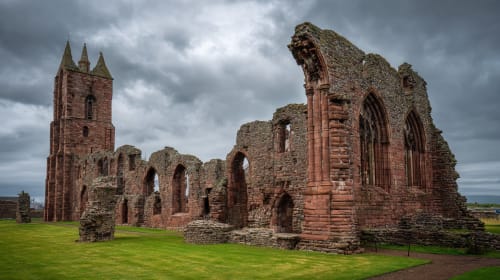
Scotland has always built with stone. For centuries there was no real alternative — what lay beneath your feet became the walls around you. Sandstone in Edinburgh, granite in Aberdeen, slate in the Highlands, whinstone wherever the ground offered it.
Then concrete arrived. Then brick. Then render. And for most of the twentieth century, the distinctive Scottish use of stone architecture declined as Portland cement, mass-production methods, and imported materials became the default.
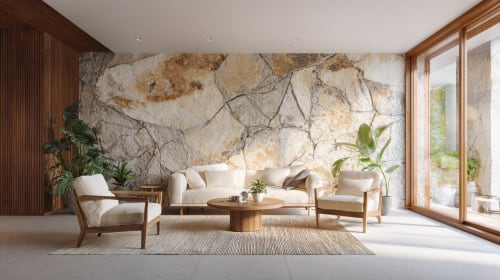
But something is shifting. Not a nostalgic return to the past — something more interesting than that. Scottish architects and homeowners are finding a new language for stone. One that acknowledges the material's heritage without being imprisoned by it. Contemporary homes where blackened timber meets exposed sandstone. Modern extensions that sit quietly alongside Victorian neighbours. Interiors where a single wall of natural stone anchors a room full of clean lines and natural light.
This is what we love about stone in Scottish contemporary homes: it is not going backwards. It is going somewhere new.
Heritage Meets Innovation
The best contemporary Scottish architecture treats stone as both heritage connector and modern material. A project might use weatherproof metal cladding as the primary external skin while celebrating exposed original stonework internally. Or new stone cladding might create visual continuity with the Victorian terraces next door while the building behind it is entirely of-its-time.
Take the approach seen in contemporary Highland renovations: birch plywood contrasting with repaired stone walls inside, while a blackened timber "jacket" sits next to an 1870s stone house outside. The old stone is not hidden or replicated — it is placed in conversation with new materials. Each makes the other more interesting.
This is not a niche movement. Planning regulations in Edinburgh, Glasgow, and conservation areas across Scotland frequently require new construction or extensions to harmonise with surrounding traditional stone architecture. There is genuine, ongoing demand for stone finishes that match or complement local stone types — and lightweight cladding systems that achieve this without the structural implications of quarried stone are part of how architects are meeting that demand.
What We Love: Stone in Scottish Contemporary Settings
The Steading Conversion
An agricultural steading in rural Angus or Perthshire, stripped back to its original stone walls and reimagined as a contemporary home. The stone is left exposed internally — honest, textured, imperfect. New interventions are clearly modern: steel-framed windows, concrete floors, minimal detailing. The original stone tells the building's story; the new elements tell the homeowner's.
Why it works: The material contrast is doing the design work. Stone needs something precise and modern next to it to feel contemporary rather than quaint. And the stone itself provides something no new material can — a three-hundred-year patina that connects the building to the landscape it sits in.
The Blackened Timber and Stone Pairing
A modern rural build — perhaps a self-build in the Cairngorms foothills or a coastal site in Fife — where blackened larch cladding meets stone at the ground floor. The timber is dark, uniform, deliberately industrial. The stone is warm, variegated, naturally textured. Together they create a building that sits in the Scottish landscape rather than sitting on it.
Why it works: Blackened timber and stone is a recurring motif in contemporary Scottish architecture, and it works because the materials share a quality of honesty. Neither pretends to be anything other than what it is. The colour contrast — dark timber, warm stone — gives the building visual weight at its base and lightness above, grounding it to the site.
The Victorian Extension
A sandstone tenement or terrace in Edinburgh, Dundee, or Glasgow, with a contemporary rear extension that introduces stone cladding as a bridge between old and new. The extension might be largely glass and steel, but a single stone-clad wall connects it visually to the original building. The stone type is chosen to complement — not match exactly — the parent building.
Why it works: Scotland's cities are full of stone buildings that need sensitive, intelligent extension. Planning officers and conservation bodies want to see new work that respects existing character without pastiche. Lightweight stone cladding that references the local sandstone palette offers architects a practical solution: the right visual language at a fraction of the weight and cost of quarried stone.
The Modern Fireplace Surround
Inside a contemporary Scottish home — new build or renovation — a fireplace surround in textured stone that anchors the living space. Not a traditional hearth with mantelpiece and corbels. A clean-edged, floor-to-ceiling stone surface with a recessed fire set into it. The stone is the architecture; the fire is just the focal point within it.
Why it works: Fireplaces remain central to Scottish living spaces — the climate demands it. A contemporary stone surround connects to that tradition while moving the aesthetic forward.
What Makes It Scottish
It would be easy to dress any contemporary interior in stone and call it Scottish. But the best examples share something specific: a relationship between the stone and the landscape outside the window.
Scottish light matters. The soft, diffused light of an overcast Angus afternoon does something to sandstone that Mediterranean sun does not — it draws out the warm undertones and softens the texture rather than bleaching it. Scottish weather matters. Stone chosen for exterior applications in Scotland needs to handle freeze-thaw cycling, wind-driven rain, and salt-laden coastal air — not as an afterthought, but as a starting condition.
And Scottish architectural tradition matters. The tenement, the steading, the whitewashed cottage, the granite terrace — these are the building types that give contemporary Scottish stone architecture its context. The new work is interesting because the old work exists alongside it.