2,500 Quarries to 14
At their peak in the 19th century, approximately 2,500 building stone quarries operated across Scotland. Stone was the default building material — not because it was fashionable, but because it was there, underfoot, in every region. Towns quarried what lay beneath them. The geology below ground became the architecture above it.
Today, 14 sandstone quarries remain active in Scotland. Only 4 are in continuous operation. Very few granite quarries survive; most produce crushed aggregate rather than dimensional building stone. There are no currently operational Scottish slate quarries — despite a long quarrying history and suitable geological resources. Scotland has no domestic source of roofing slate.
The Scottish stone industry currently produces roughly one-tenth of the stone used in Scotland annually. Approximately 160 people are employed in the building stone industry. Over 5 million tonnes of building stone are imported into the UK each year, and the cost of imported stone has almost doubled since 2015.
These numbers describe a collapse. Understanding how it happened — and what’s beginning to change — matters for anyone building, specifying, or conserving in Scotland today.
---
What Happened
The decline didn’t happen overnight. It was gradual, driven by a combination of economics, technology, and shifting materials culture.
In the 20th century, the distinctive Scottish use of stone architecture was progressively replaced by Portland cement, concrete, and mass-production brick. Glass, steel, and concrete became the default construction materials — cheaper to produce, faster to build with, and suited to the scale and speed of post-war reconstruction.
The granite industry illustrates the pattern. Aberdeen once had approximately 150 granite quarries. By the 1960s, newer materials had made granite construction economically uncompetitive for most applications. Rubislaw Quarry — one of the biggest man-made holes in Europe, which had produced an estimated six million tonnes over approximately 200 years — was the last in Aberdeen to close, in 1971.
The same story repeated across the country. Quarries closed one by one. The skills to operate them — and to work the stone they produced — declined with them. Traditional stonemasonry became a niche rather than a mainstream trade.
Stone was retained in some contexts. Edinburgh, Aberdeen, and Dumfries continued building with it, and periodic revivals kept quarries alive for prestige projects. But the overall trajectory was clear: away from local stone and toward manufactured materials.
---
Why It Matters Now
The consequences of this decline are not abstract. They’re visible on every street with a traditional stone building.
Conservation and Repair
Traditional buildings — those built before 1919 — account for 19% of Scotland’s building stock. Research indicates that 75% of these traditional buildings show disrepair, and 53% show urgent disrepair.
Traditional buildings are of "breathable construction" — the materials can absorb and release moisture. They use permeable materials such as stone and lime mortars. When modern impermeable materials (concrete, cement) are used in repairs, moisture gets trapped in the building fabric, causing damp, mould, and dry rot.
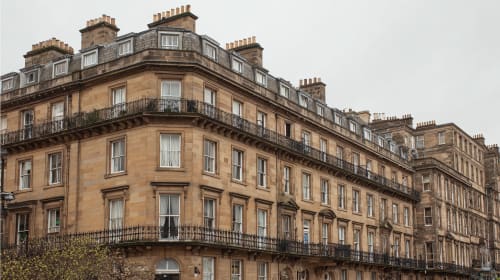
The loss of the stone industry means the loss of appropriate repair materials. When a sandstone tenement in Glasgow needs repointing or stone replacement, the original stone type may no longer be quarried. Imported alternatives may not match in colour, texture, porosity, or weathering characteristics. Inappropriate repairs don’t just look wrong — they can accelerate the very decay they’re meant to prevent.
Historic Environment Scotland has documented this problem extensively. The use of inappropriate materials in repairs contributes to and, in some cases, accelerates stonework decay. Aggressive cleaning methods — once popular, now understood to be damaging — have compounded the issue, destroying the natural protective patina that stone develops over decades and, in the worst cases, accelerating natural decay by 6 to 10 times.
Supply Chain and Cost
The economics have shifted. Over 5 million tonnes of building stone are imported into the UK annually. The cost of imported stone has almost doubled since 2015. Roofing slate imports — filling the gap left by Scotland’s closed slate quarries — command the highest price of all imported stone.
For architects and specifiers working on heritage projects in Scotland, sourcing appropriate stone means navigating an import-dependent supply chain with rising costs, long lead times, and limited ability to match specific local stone types. The irony is acute: Scotland sits on the geological resources to supply its own needs, but the infrastructure to extract and process them has largely disappeared.
Skills
A major barrier to revival is the lack of knowledge and skills. The indigenous building stone industry has been near-absent for much of the past century. The people who can operate quarries, extract dimensional stone, and work it to building standards are far fewer than the need demands.
This skills gap affects not just quarrying but traditional stonemasonry itself. The craft of building with stone — understanding lime mortars, breathable construction, pointing techniques suited to specific stone types and exposures — requires training, experience, and continuity that an interrupted industry struggles to maintain.
---
What’s Changing
The picture isn’t entirely bleak. There are signs of renewal — driven by heritage need, sustainability arguments, and emerging economic logic.
The BGS/HES Report
In November 2024, the British Geological Survey and Historic Environment Scotland published a joint report examining Scotland’s building stone capacity. The conclusion was significant: Scotland is "more than capable of being self-sufficient" regarding building stone requirements.
The report identified 139 disused building stone quarries and 31 quarries currently supplying only crushed aggregate that could potentially supply a significant proportion of Scotland’s building stone needs. The raw material is there. The question is whether the investment and procurement innovation follow.
The Sustainability Case
A renewed Scottish building stone market would create rural skilled jobs, reduce carbon emissions from importing stone across continents, and improve conservation outcomes for historic buildings. The environmental argument is difficult to counter: stone quarried in Scotland and used in Scotland has a fundamentally different carbon footprint from stone quarried in India or China and shipped to Aberdeen.
There’s also a lifecycle argument. Stone lasts. The buildings of Edinburgh, Glasgow, Aberdeen, and Dundee have demonstrated this over centuries. A building material that survives 200 years of Scottish weather without replacement has sustainability credentials that few modern alternatives can match — regardless of their manufacturing efficiency.
Active Quarries
Scotland still has working stone. Locharbriggs Quarry in Dumfries has been operating since the 18th century and continues to produce the distinctive red Permian sandstone that built Dumfries and reached as far as New York. Clashach quarry near Hopeman in Moray produces excellent durable sandstone in white, red, brown, and variegated colours. Pitairlie Quarry in Angus — reopened in 2004 — is the sole source of Angus sandstone in the world.
The Caithness flagstone industry is enjoying a revival as natural paving becomes popular for streetscaping and landscaping. Active granite quarries at Kemnay and Corrennie mainly produce aggregate but can supply dimensional stone for prestige projects.
These are not relics. They’re working operations that demonstrate the viability of Scottish stone production. What they need is consistent demand — from specifiers willing to source Scottish, from planners willing to require it, and from a building culture willing to value provenance alongside price.
---
What This Means for Building in Scotland
Every material choice on a Scottish project is, whether we think about it or not, a vote for a particular supply chain. Imported stone sustains quarries and shipping routes elsewhere. Scottish stone sustains quarries, skills, and communities here.
For heritage and conservation projects, the argument is strongest. Using stone that matches the original — in type, porosity, weathering characteristics, and appearance — isn’t a luxury. It’s the difference between a repair that protects the building for another century and one that accelerates its decline.
For new builds and renovations, the choice is more nuanced. Modern stone cladding products offer the visual and tactile qualities of natural stone at weights and costs that traditional full-depth stone cannot match. They make stone achievable on projects where it would otherwise be impractical — feature walls, lightweight substrates, retrofit applications.
The question connecting both contexts is the same one the BGS/HES report poses: can Scotland reconnect with its stone? The geology hasn’t changed. The skill can be rebuilt. The demand exists, from conservation need to new-build aspiration. What’s needed is the decision — project by project, specification by specification — to choose stone, and where possible, to choose Scottish.
Related reading: Scotland’s Building Stone: A Complete Guide to Types, History & Where to See Them
Related reading: What Scottish Stone Teaches Us About Choosing Cladding That Lasts
Related reading: Stone Cladding vs Render in Scotland: Which Is Right for Your Project?
Related reading: We Love: The Angus Stone Story — From Arbroath Abbey to Modern Craft
Related reading: We Love: Aberdeen — The Granite City